Newsletter engine
An email sending platform on Amazon SES with queues, tracking, bounces and automations, and no per-contact fees.
Newsletters and automated sequences that land in the right inbox and bring customers back.
Marketing
You have a customer list but do not use it, or you send the odd email and have no idea whether anyone reads it. Meanwhile, people who have already bought from you forget about you, and you pay for ads to bring them back.
With us, email becomes a channel that works consistently: we set up your domain so emails reach the inbox, write the content with you and create sequences that start on their own when someone signs up, buys or is about to lapse.
Gmail, Outlook and other email services decide in an instant whether an email can be trusted. They mainly look at two things: whether the sender is who they claim to be, and how the list behaves.
The first needs three domain settings, which only have to be done once:
Without these three records, the major email services now tend to reject bulk sends or move them to spam.
The second part is list hygiene. Wrong or closed addresses cause bounces, and people who have not opened anything for months lower your reputation. That is why we remove bounces automatically, make unsubscribing easy and periodically set inactive contacts aside.
They do different jobs, and it usually pays to have both.
A newsletter goes to everyone or to a group, on a date you choose: news, offers, an article, an event. It keeps the relationship alive and takes a bit of work each month.
Automated sequences are triggered by something the person does: they sign up and get a three-email welcome series, they leave their basket and a few hours later get a reminder, their subscription expires in a month and they get a notice. You write them once and they keep working. If you are short of time, this is often the best place to start.
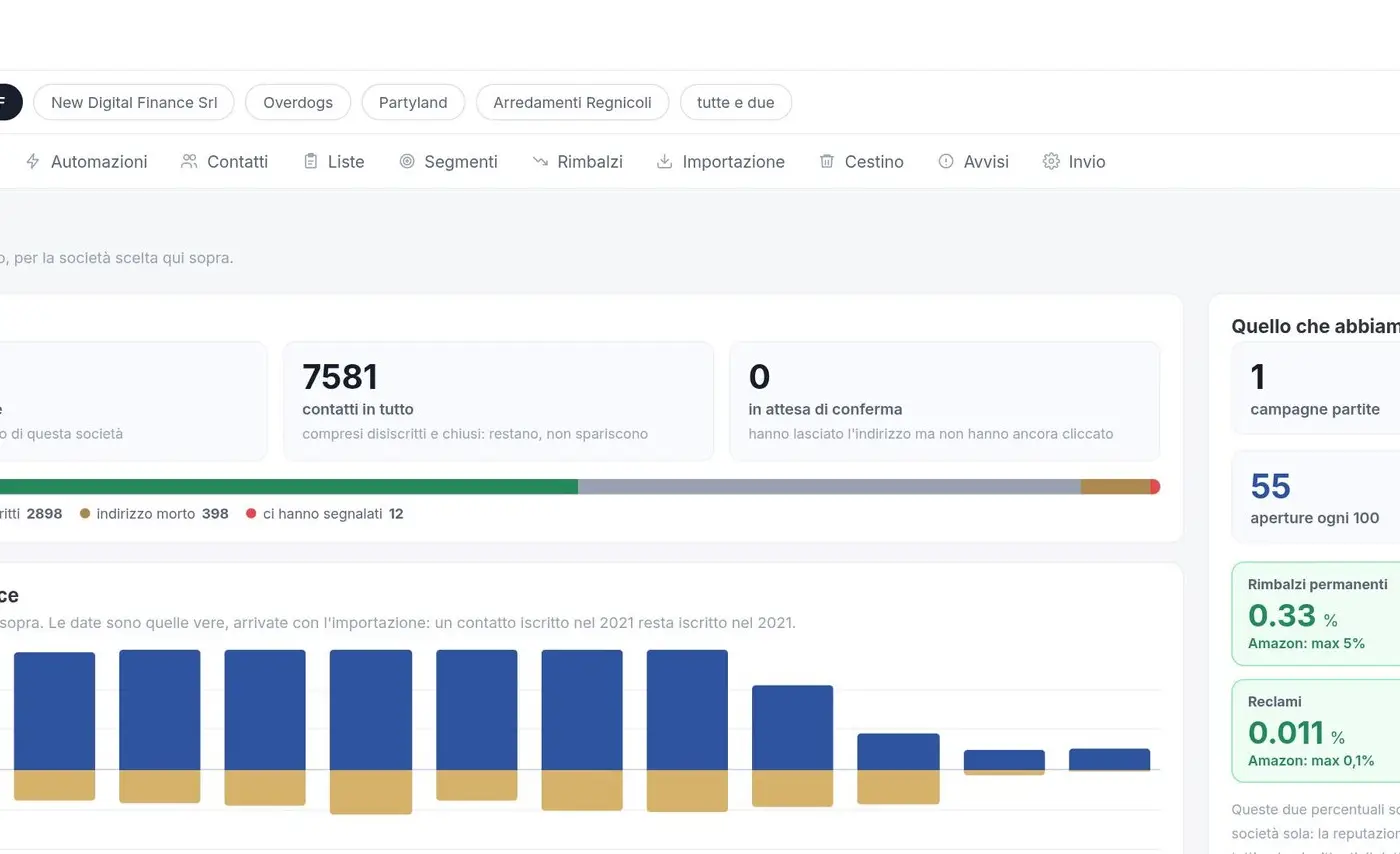
For our own companies we replaced MailerLite with our own sending engine built on Amazon SES: it manages queues, tracks opens and clicks, removes bounces and triggers sequences. The cost is Amazon SES pricing, a few cents per thousand emails, with no per-contact fee. The Newsletter module of our multi-company business platform also sends through Amazon SES, in the same software that holds the CRM.
Shops, restaurants, professionals and businesses in Perugia and Umbria, Italy, and clients working with us remotely, who already have customers and want to stay in touch more often without relying only on social media or advertising.
No. Even a few hundred contacts who know you are worth more than a large bought list. We start with the customers you already have and add a simple sign-up option to your website.
We advise against it. Apart from the privacy issues (GDPR requires explicit consent), bought addresses generate bounces and spam reports, and damage your domain's reputation even for your everyday emails.
That is up to you. We can work with the platform you already use, if it is suitable, or with our own sending engine on Amazon SES, which has no per-contact cost and suits growing lists.
As often as you can keep up with useful content. For many businesses once or twice a month is a good starting point; consistency matters more than the number of sends.
We check your domain setup, the reputation of the sending server and the state of your list. The problem is usually in one of these three places, and once it is fixed, delivery gets back to normal within a few weeks.
An email sending platform on Amazon SES with queues, tracking, bounces and automations, and no per-contact fees.